> For the complete documentation index, see [llms.txt](https://docs.workfx.ai/llms.txt). Markdown versions of documentation pages are available by appending `.md` to page URLs; this page is available as [Markdown](https://docs.workfx.ai/workfx-1.1.x-english/workspace/audit-logs.md).
# Audit Logs
### 1 Introduction
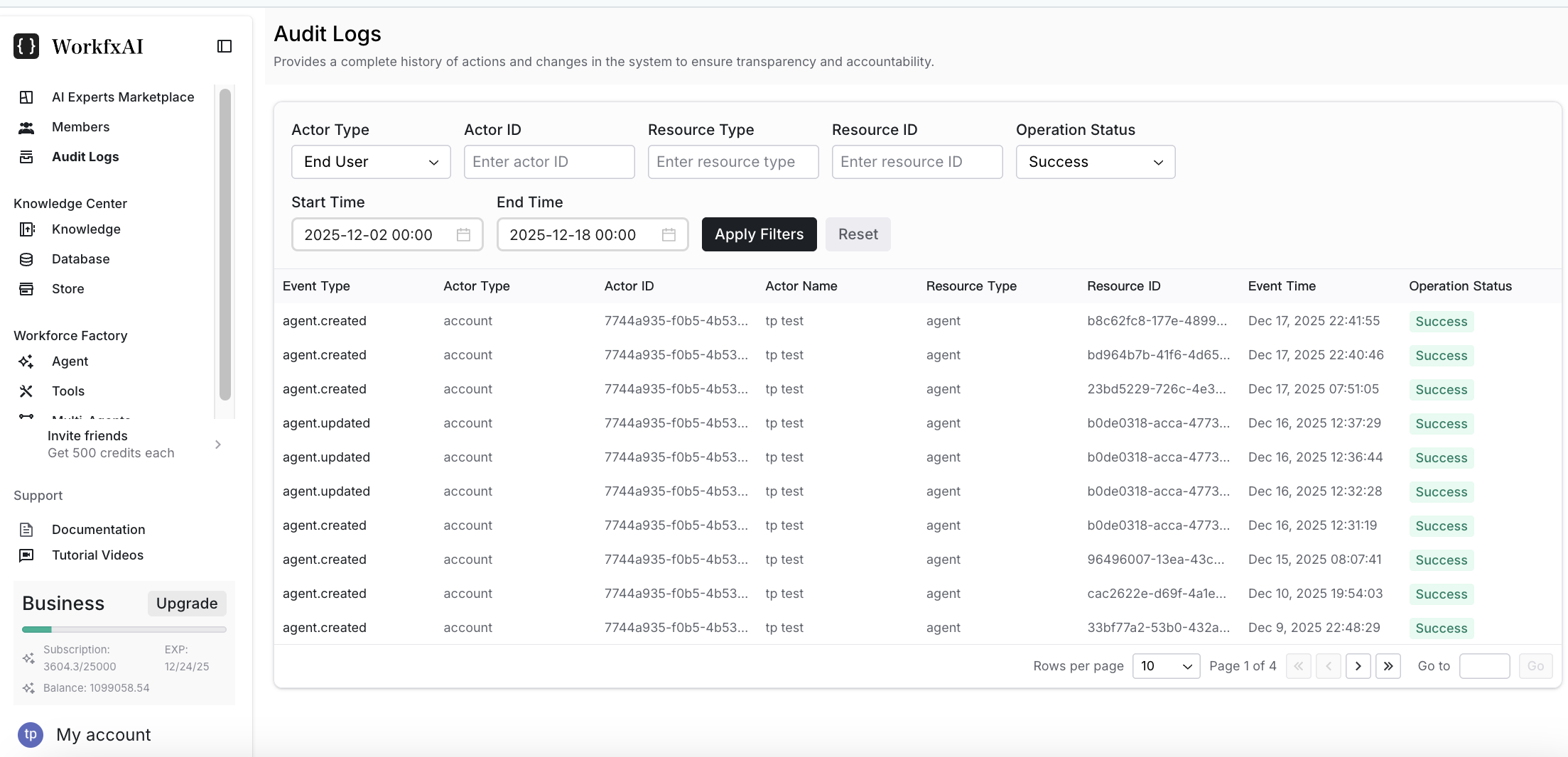
The Audit Logs page shows a history of actions and changes in the system. You can use filters to locate specific events by actor, resource, time range, and status.
### 2 Open Audit Logs
1. In the left navigation, click Audit Logs.
2. The page includes:
* A filter panel at the top
* An audit log table below
### 3 Filter Audit Logs
Use the filter panel to narrow down results:
* Actor Type: select the actor type (e.g., account)
* Actor ID: input the actor identifier
* Resource Type: input the resource type (e.g., agent, knowledge, database, table, etc.)
* Resource ID: input the target resource identifier
* Operation Status: select status (e.g., Success / Failed)
* Start Time / End Time: select a datetime range
**Steps:**
1. Set one or more filters.
2. Click Apply Filters to refresh the results.
3. Click Reset to clear all filters.
### 4 Read Audit Log Records
Each row in the table represents one audit event. Common columns include:
* Event Type: action type (e.g., agent.created, agent.updated)
* Actor Type / Actor ID / Actor Name: who performed the action
* Resource Type / Resource ID: what resource was affected
* Event Time: when the event happened
* Operation Status: result of the action (e.g., Success)
### 5 Pagination
Use the bottom controls to navigate:
* Change Rows per page
* Move between pages
* Jump to a specific page (if available)
---
# Agent Instructions
This documentation is published with GitBook. GitBook is the documentation platform designed so that both humans and AI agents can read, navigate, and reason over technical content effectively. Learn more at gitbook.com.
## Querying This Documentation
If you need additional information that is not directly available in this page, you can query the documentation dynamically by asking a question.
Perform an HTTP GET request on the current page URL with the `ask` query parameter, and the optional `goal` query parameter:
```
GET https://docs.workfx.ai/workfx-1.1.x-english/workspace/audit-logs.md?ask=&goal=
```
`ask` is the immediate question: it should be specific, self-contained, and written in natural language.
`goal` is optional and describes the broader end goal you are ultimately trying to accomplish on behalf of the user. GitBook uses it to tailor the answer towards what is most useful for that goal.
The response will contain a direct answer to the question and relevant excerpts and sources from the documentation.
Use this mechanism when the answer is not explicitly present in the current page, you need clarification or additional context, or you want to retrieve related documentation sections.